The premise of emdash-geo-seo is that modern visibility requires optimizing for two different audiences: Google’s crawler, which has worked the same way for years, and the AI assistants — ChatGPT, Claude, Perplexity, and Google AI Overviews — that are now answering questions directly and citing their sources. A high Google ranking is no longer sufficient if an AI assistant cannot read your page, understand who authored it, and quote it confidently. The plugin handles both tracks from a single configuration source.
Running the Test
To validate that the plugin was working as intended, I ran a scan on xeoscan.ai , a free tool that checks roughly 40 signals across eight areas specifically relevant to AI citation-readiness alongside classic SEO fundamentals. XEOscan deliberately skips JavaScript execution — it fetches raw HTML, exactly as AI crawlers like GPTBot, ClaudeBot, and PerplexityBot do — which makes its results a realistic proxy for what those crawlers actually see.
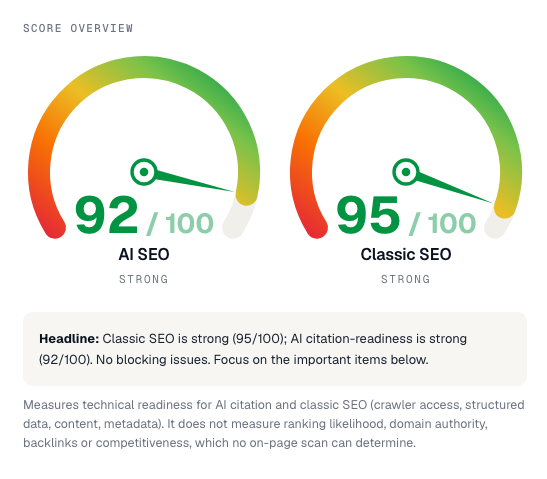
The results were strong. The site scored 92 out of 100 for AI SEO and 95 out of 100 for Classic SEO, with no blocking issues identified. XEOscan’s own headline: “Classic SEO is strong (95/100); AI citation-readiness is strong (92/100).” Both categories sit in the Strong band, which means no structural barriers are standing between the site and AI citation.
What the Plugin Contributed
Unpacking those scores against what emdash-geo-seo actually ships helps identify what is doing the work. Crawler access came through clean: the plugin writes a robots.txt with explicit allow directives for the 13 AI user-agents XEOscan checks — GPTBot, ClaudeBot, PerplexityBot, and others — so no AI crawler is inadvertently blocked.
Structured data accounted for a meaningful share of the AI SEO score. The plugin generates JSON-LD markup for every page — Organization, WebSite, WebPage, and Article schemas where appropriate — using the settings configured in the admin UI. XEOscan checks whether a page can supply factual snippets that an AI answer can lift verbatim, so clean, complete JSON-LD directly improves citability.
The llms.txt file at the root of the site signals to AI crawlers which pages are canonical and machine-readable. This is a relatively new convention, but XEOscan checks for it, and its presence contributed to the discoverability component of the score.
Authorship and freshness — two signals that determine whether an AI assistant trusts a page enough to cite it — are handled through the bylines system built into EmDash and surfaced in the JSON-LD the plugin emits. Each article carries a visible author, a published date, and a modified date, all of which appear in both the HTML and the structured data.
What Is Left to Improve
The eight-point gap to a perfect AI SEO score is worth investigating. XEOscan’s rubric is open, which means each deducted signal can be audited individually. At this score level the most likely candidates are content-shape issues — whether pages are structured as clear questions and answers — and page speed, which feeds Core Web Vitals and carries some weight in AI-readability as well. Those are content and hosting decisions, not plugin decisions, and both are addressable without changes to emdash-geo-seo itself.
Conclusion
A 92/100 AI SEO score with no blocking issues means the site is technically ready to be cited by AI assistants. emdash-geo-seo removed all the structural barriers — crawler access, structured data, llms.txt, canonical URLs — in a single plugin install with no redeployment required to change a setting. The remaining delta lives in content quality and page speed, which is exactly where it should be.